
Why did kabbalists draw trees?

If you’ve ever looked at a kabbalistic ilan, one question presents itself almost immediately:
Why a tree?
Why did generations of kabbalists choose this particular form to express some of Judaism’s most profound and complex teachings?
The answer is rooted in the challenges kabbalists faced when attempting to represent the divine world. The tree offered a way to express complex relationships, convey symbolic meaning, and make abstract teachings more accessible to study and contemplation.
The result was one of the most distinctive visual traditions in Jewish history.
More than a symbol
For medieval and early modern kabbalists, however, the tree was also a tool.
Long before flowcharts, infographics, or digital diagrams, scholars used tree structures to organize complex systems of knowledge. Philosophers, theologians, jurists, and scientists all employed arboreal diagrams to visualize relationships between ideas. A higher position within the tree often implied a causal relationship to what appeared below it, whether in a genealogy, a philosophical system, or a hierarchy of being.
Kabbalists inherited this broader intellectual tradition and adapted it to their own purposes. The tree schema offered a widely understood way of representing relationships without implying physical form or spatial location. This was particularly important in Kabbalah, where the sefirot were understood as aspects of the divine world rather than corporeal entities. The familiar language of the tree helped make these relationships intelligible while avoiding the suggestion that the Divine itself possessed bodily form.
The ten sefirot, the divine emanations through which kabbalists understood God’s relationship to creation, lent themselves naturally to a visual structure. Relationships that might require many pages of explanation could be represented at a glance. Higher and lower, right and left, source and recipient all became visible within a single framework.
What distinguished ilanot from the tree diagrams found in many medieval books was their scale and ambition. Rather than appearing as small illustrations embedded within a text, ilanot were often inscribed on large parchment sheets or scrolls. The tree itself became a framework for collecting and arranging knowledge.
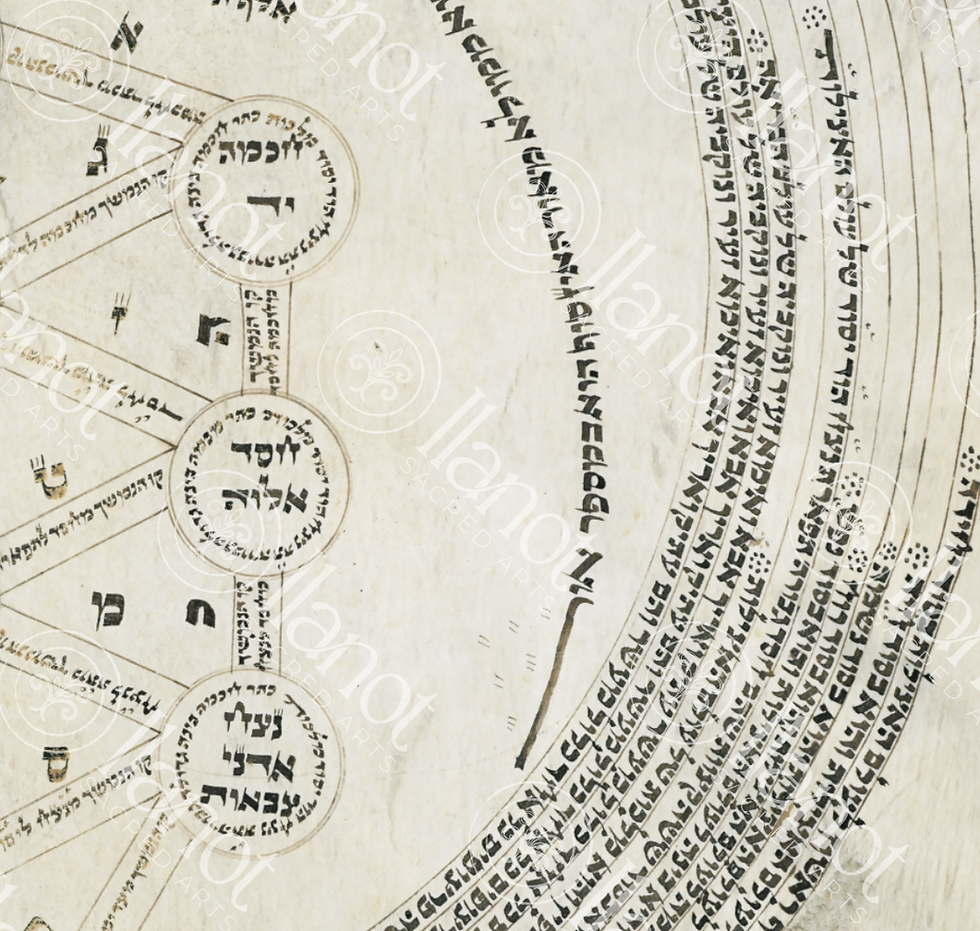
The medallions representing the sefirot provided dedicated spaces in which scribes could gather divine names, scriptural associations, and teachings connected to each sefirah. Even the channels linking the sefirot were often inscribed with texts explaining their role in the transmission of shefa, the divine abundance that flows through the sefirotic tree. The result was not simply a diagram, but a visual anthology of kabbalistic learning.
Mapping the divine world
Kabbalists used the tree as a way of representing relationships within the divine world. It provided a visual grammar for thinking about processes that could not be seen directly.
Kabbalah is deeply concerned with questions that resist simple description. How does the infinite relate to the finite? How does divine abundance enter the world? How are seemingly separate aspects of reality connected?
A tree could help hold these questions together. Its branching structure suggests both unity and multiplicity, a single source giving rise to many expressions without losing its coherence. The image offered a way of contemplating how diversity emerges from unity, a theme that lies at the heart of much kabbalistic thought.
For many kabbalists, this was not merely an intellectual exercise. Understanding the structure of the divine world was a way to deepen prayer, sharpen spiritual awareness, and help orient one’s life toward God. The tree therefore served not only as a diagram, but as an aid to contemplation and study.
When diagrams become manuscripts
One of the most surprising aspects of historical ilanot is their scale.
Modern readers often assume that diagrams exist to simplify information. Many ilanot do exactly the opposite. Over time, kabbalists continued to add texts, commentaries, divine names, biblical citations, and increasingly sophisticated cosmological teachings. Some evolved into vast visual encyclopedias of kabbalistic knowledge.
A remarkable example appears in the family of ilanot known today as Magnificent Parchments.
One striking example is the Oxford Magnificent Parchment, a Renaissance Italian ilan composed of multiple stitched parchment membranes and containing more than 33,000 words of kabbalistic text integrated into its visual structure. Ilanot of this magnitude and detail are entire worlds of learning, arranged in visual form.

The Magnificent Parchments also reveal something important about the purpose of these trees. Even the shape of the diagram could carry theological meaning.
In many later depictions of the sefirot, the upper three emanations are arranged in a triangular pattern. The Italian kabbalists responsible for the Magnificent Parchment tradition often preferred a different arrangement, placing these highest sefirot in a vertical column. This reflected their belief that these exalted levels of divinity transcended the distinctions symbolized by right, left, and center. In many kabbalistic systems, those positions carry specific associations and modes of divine activity. The highest sefirot, in this view, stood beyond such differentiation.
Why the tree endured
The continued production of ilanot over many centuries suggests that the tree remained an effective vehicle for kabbalistic thought. It allowed students to visualize relationships that might otherwise remain scattered across many texts and traditions.
Just as importantly, it gave visual expression to a central kabbalistic insight: that the apparent complexity of existence ultimately emerges from a deeper unity. That idea remains compelling today.
Many contemporary students of Kabbalah continue to find value in visual representations of the sefirot and the divine world. Some use them as study aids. Others incorporate them into contemplative or spiritual practice. The particulars may differ from one person to another, but the underlying appeal remains much the same as it was centuries ago. Certain ideas become easier to understand - experience, even - when they can be seen as well as read.
Seeing the tree today
Historical ilanot occupy a unique space between art, scholarship, and spiritual practice. They preserve some of the most sophisticated ideas in the kabbalistic tradition through image as much as text, which may help explain their enduring appeal.
A skillfully designed ilan invites sustained engagement. The eye follows pathways, connections emerge, and relationships become visible. What begins as a diagram gradually reveals itself as a way of thinking.
For readers interested in exploring the subject further, Prof. J. H. Chajes’s The Kabbalistic Tree remains the most comprehensive introduction to the history, development, and meaning of the ilan tradition. More information about the book, including a special discount available to readers of this site, can be found on our About page.
For those who wish to encounter these remarkable works first-hand, surviving ilanot continue to reward careful study, whether in archives, digital collections, or fine art reproductions that allow their extraordinary visual richness to be experienced at full scale.
Comments